
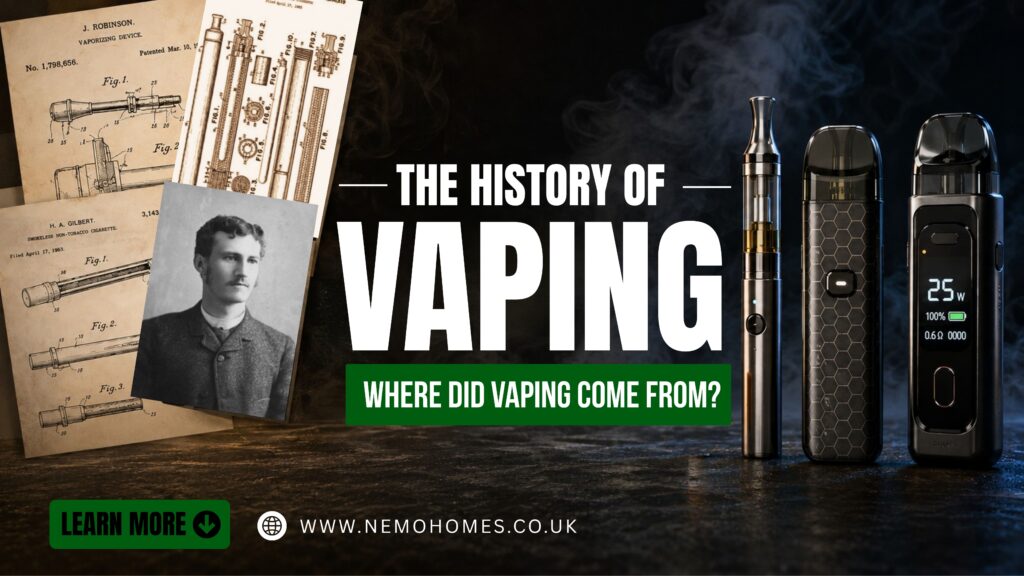
Vaping might seem like a relatively new idea, but the story behind electronic cigarettes actually goes back much further than you might expect.
From early inventions in the 1920s to the modern devices available today, vaping technology has gone through several stages of development. Here’s a simple look at how it all began and how the technology evolved.
What Is Vaping?
Vaping involves using an electronic device that heats a liquid and turns it into an aerosol or vapour, which is then inhaled.
Modern devices are designed around a fairly simple principle: a battery powers a heating element, which heats the liquid inside a pod or tank.
Although today’s devices are much more advanced, the basic idea of creating an alternative to traditional cigarettes has been around for decades.
Who Invented Vaping?
The history of electronic cigarettes can be traced back to Joseph Robinson, who filed a patent for an electronic vaporising device in 1927.
The patent was later granted in 1930. However, the device was never brought to the commercial market, so it is difficult to know how far development actually progressed.
For this reason, Robinson is better described as an early pioneer of the concept rather than the creator of the modern electronic cigarette.
Herbert A. Gilbert and the First Modern E-Cigarette
Another important name in the history of vaping is Herbert A. Gilbert.
In 1963, Gilbert filed a patent for what he described as a smokeless, non-tobacco cigarette. He also developed working prototypes based on the idea.
The concept was remarkably similar to the basic principle behind modern electronic cigarettes: instead of burning tobacco, the device would produce an inhalable vapour.
Despite the idea being ahead of its time, it did not become a successful commercial product.
The 1990s: Technology Starts Moving Forward
For several decades, different inventors and companies experimented with electronic alternatives to traditional cigarettes.
However, the technology wasn’t quite ready to become mainstream.
The situation began to change during the 1990s, as improvements in batteries, electronics and heating technology made electronic smoking devices increasingly practical.
These developments helped create the foundations for the devices we recognise today.
Hon Lik and the Modern E-Cigarette
Hon Lik, a Chinese pharmacist, is widely credited with developing the first successful modern generation of electronic cigarettes.
His work in the early 2000s helped turn the concept into a commercially viable product.
In 2003, Hon Lik produced a working version of the type of electronic cigarette that would eventually lead to today’s industry.
Electronic cigarettes subsequently began appearing in international markets, with products reaching Europe in 2006 and the United States later that year.
This marked an important turning point in the history of vaping.
Why Did Vaping Become Popular?
One of the main reasons behind the development of electronic cigarettes was the search for an alternative to traditional smoking.
As awareness of the health risks associated with smoking increased throughout the 20th century, interest grew in alternatives that did not involve burning tobacco.
Electronic cigarettes offered a different approach by using a battery-powered heating system rather than traditional combustion.
Over time, the technology continued to develop, with manufacturers introducing different device designs, liquids, flavours and features.
The Rise of Modern Vape Devices
Early electronic cigarettes were relatively simple compared with the devices available today.
As the industry developed, devices evolved into several different formats, including:
- Cigarette-style devices designed to resemble traditional cigarettes
- Pen-style devices with rechargeable batteries and refillable tanks
- Pod systems designed around compact, replaceable pods
- Advanced devices offering adjustable power, airflow and other controls
This development made the technology more varied and gave adult consumers different device formats to choose from.
The Disposable Vape Ban in the UK
The UK vaping market has also changed significantly in recent years.
Disposable vapes were banned from sale in the UK from 1 June 2025, meaning businesses can no longer legally sell single-use disposable vape products.
The change has shifted attention towards rechargeable and reusable alternatives.
This has also contributed to greater interest in pod systems and rechargeable devices that can be used with replaceable pods or cartridges.
How Vaping Has Changed Over Time
Looking back, the development of vaping has been a long process rather than something that appeared overnight.
The timeline can be simplified like this:
1927 → Joseph Robinson files an early electronic vaporising device patent
1963 → Herbert A. Gilbert develops and patents a smokeless, non-tobacco cigarette concept
1990s → Advances in technology help make electronic devices more practical
2003 → Hon Lik develops a successful modern electronic cigarette
2006 → Electronic cigarettes begin appearing in European and US markets
2013 → Vype launches
2025 → The UK disposable vape ban comes into effect
Each stage helped shape the technology into the wide range of rechargeable and pod-based devices available today.
What Does the Future Look Like?
Vaping technology continues to change.
Modern devices are becoming increasingly focused on convenience, rechargeable designs, pod compatibility and improved electronic features.
At the same time, regulations are having a major influence on which products can be sold and how they are marketed.
For consumers, this means the products available today can look very different from the early electronic cigarettes that appeared decades ago.
Final Thoughts
The history of vaping is much older than many people realise.
What started as an idea for creating a smokeless alternative eventually developed through decades of experimentation, technological improvements and changing consumer demand.
From Joseph Robinson’s early patent and Herbert A. Gilbert’s prototypes to Hon Lik’s successful modern design, each stage played a part in shaping the technology we recognise today.
More than a century after the earliest concept was patented, electronic devices have become a significant part of the nicotine market — while regulation continues to shape where the industry goes next.
18+ only. Nicotine is addictive. Vaping products are not risk-free and are intended for adult nicotine consumers.