
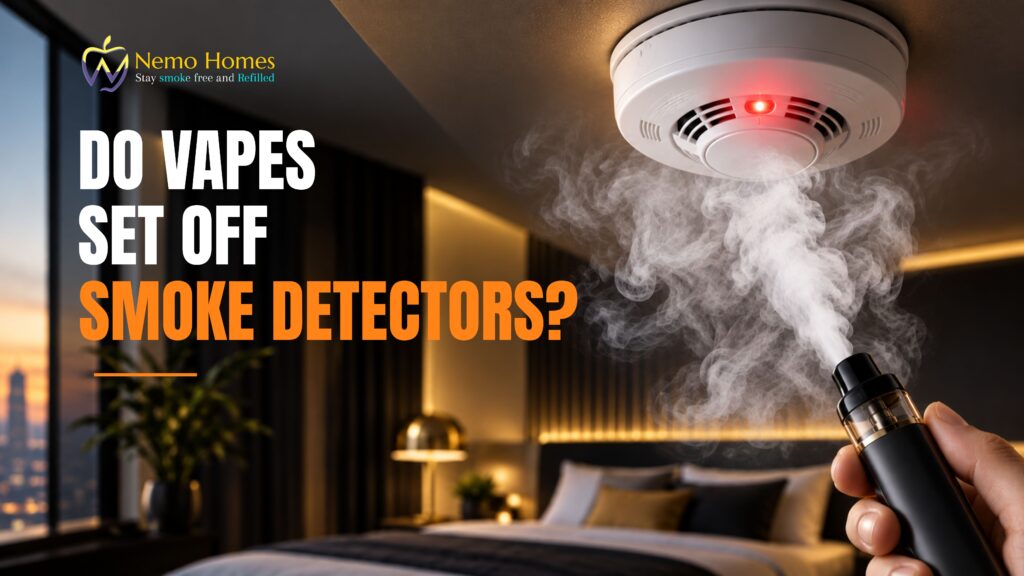
Yes, vaping can set off a smoke detector. Vape devices produce vapour rather than tobacco smoke, but some alarms can still detect the tiny airborne particles in that vapour.
Whether an alarm goes off depends on several things, including the type of detector, how much vapour is produced, how close you are to the alarm, and how well ventilated the room is.
This is particularly important in enclosed spaces such as hotel rooms, offices and other indoor areas where vapour can build up more easily.
Why Can Vape Vapour Trigger a Smoke Alarm?
Smoke detectors don’t all work in the same way.
Some are designed to detect heat, while others detect changes in the air caused by airborne particles. Because vape aerosol contains suspended droplets, certain detectors may respond to it even though there is no burning tobacco involved.
That means the type of alarm installed can make a big difference.
Which Smoke Detectors Are Most Likely to Detect Vape Vapour?
Heat Detectors — Unlikely
Heat detectors respond to a significant increase in temperature rather than looking for smoke particles.
Because normal vape use doesn’t create enough heat to noticeably raise the temperature of a room, these detectors are unlikely to be triggered by vape vapour.
They should still never be covered, disabled or interfered with.
Ionisation Smoke Alarms — Less Likely
Ionisation alarms detect changes within an electrically charged sensing chamber.
When smoke or other airborne particles enter that chamber, they can disrupt the electrical current and cause the alarm to activate.
Vape aerosol may potentially interfere with this process, although ionisation alarms are generally less likely to react to vaping than photoelectric alarms.
Photoelectric or Optical Smoke Alarms — Most Likely
Photoelectric alarms are the ones you need to be particularly aware of.
These detectors use a light source and sensor inside a detection chamber. When enough airborne particles enter the chamber, they scatter the light. If sufficient scattered light reaches the sensor, the alarm can activate.
Dense vape aerosol can potentially produce this effect.
The more vapour in the air—and the closer it is to the detector—the greater the chance that an optical alarm could respond.
Does the Amount of Vapour Matter?
Yes.
A small amount of vapour in a large, well-ventilated area is different from producing dense clouds in a small enclosed room.
Factors that can increase the chance of triggering a detector include producing large amounts of vapour, poor ventilation, being close to the detector and allowing vapour to accumulate indoors.
However, there’s no reliable amount or distance that guarantees an alarm won’t activate.
Can Vaping Set Off a Hotel Smoke Alarm?
It can.
Hotels commonly have sensitive fire-detection systems, and their policies may prohibit vaping inside rooms regardless of whether vaping is otherwise permitted in a particular location.
Even if you think the detector won’t react, you should follow the hotel’s smoking and vaping policy rather than trying to avoid triggering the alarm.
Can Vaping Set Off an Aeroplane Smoke Detector?
Vaping should not be attempted on an aircraft.
Aircraft have strict rules concerning smoking and vaping, and sensitive detection equipment may be installed in areas such as toilets.
Keep your device stored appropriately and follow the airline’s instructions throughout your journey.
What About Vaping Indoors in the UK?
Whether vaping is permitted indoors often depends on the rules of the particular venue.
Businesses, workplaces, hotels, restaurants, transport operators and other property owners can establish their own vaping policies.
So even when there isn’t a general legal prohibition applying to a particular indoor space, that doesn’t automatically mean vaping is allowed there.
Check the venue’s rules before using your device indoors.
Should You Cover a Smoke Detector While Vaping?
No.
Never cover, remove, disable or interfere with a smoke or fire detector to prevent it from detecting vapour.
These systems are there for fire safety. If vaping isn’t permitted or there is a chance it could interfere with the alarm system, the appropriate option is to use the device somewhere vaping is permitted.
Final Thoughts
So, can vapes set off smoke detectors? Yes, they can.
The likelihood depends largely on the type of detector and the concentration of vapour in the air. Heat detectors are unlikely to react, ionisation alarms may react in some circumstances, and photoelectric or optical alarms are generally the biggest concern because airborne vape particles can interfere with their light-based detection system.
The simplest approach is not to try to work out whether you can vape without triggering an alarm. Check the rules of the building or venue and only vape where it is permitted.
Looking for more straightforward vaping guides? Explore our latest guides and troubleshooting tips at Nemo Homes.
Vaping products containing nicotine are intended for adults and are not risk-free. Nicotine is addictive.