
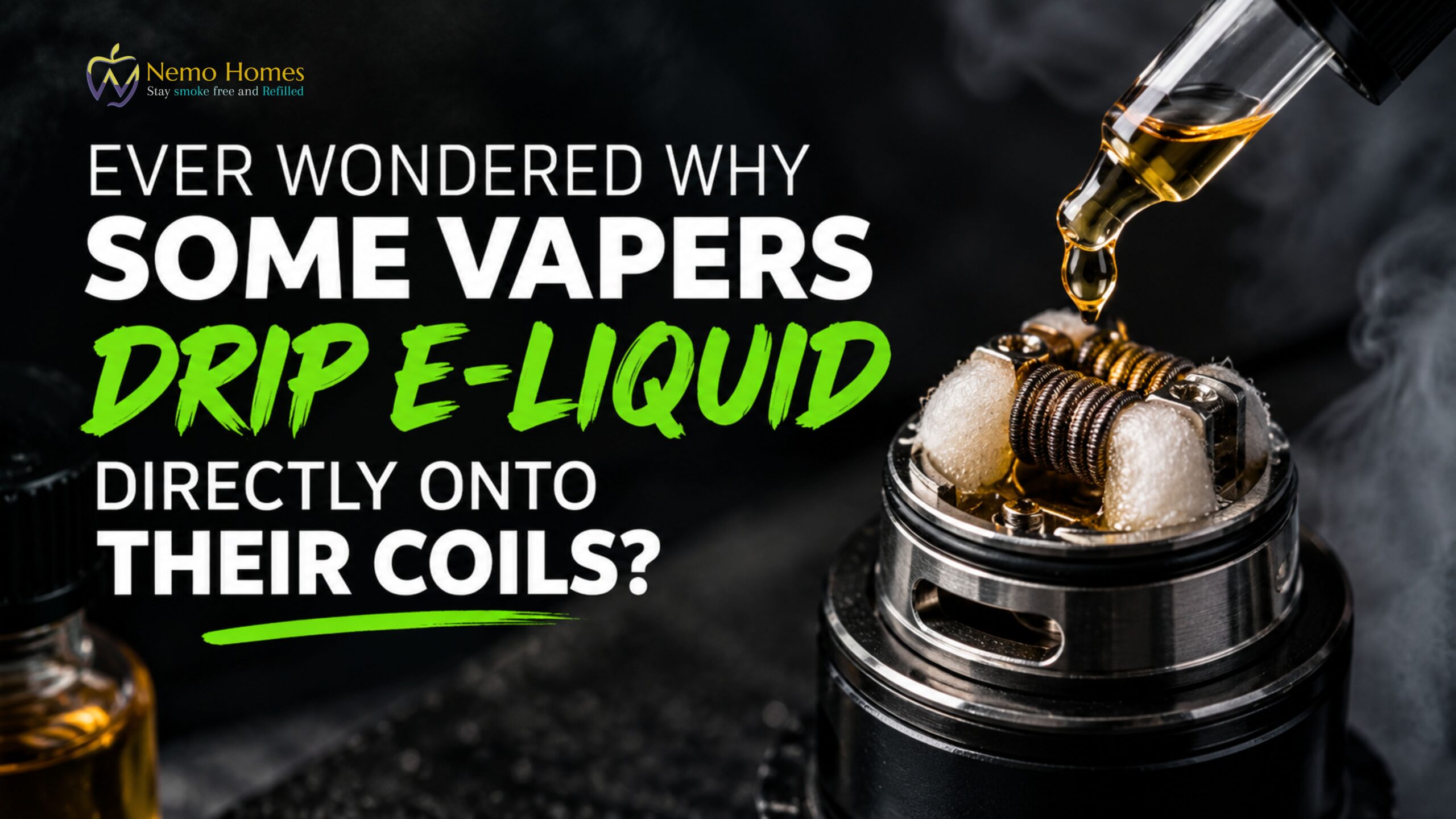
If you’ve been vaping for a while, you may have come across the term drip vaping or heard experienced vapers talking about RDAs.
But what exactly is drip vaping, and how is it different from using a regular vape tank or pod?
Drip vaping is a more hands-on way of vaping that gives users greater control over their coils, wicking material and e-liquid. Instead of relying on a tank to hold and supply the e-liquid, you apply it directly to the cotton inside a specialised atomiser.
In this guide, we’ll explain how drip vaping works, the equipment involved, its advantages and disadvantages, and why it’s generally better suited to experienced vapers.
What Does Dripping Mean in Vaping?
Drip vaping, often simply called dripping, is a vaping method where e-liquid is applied directly to the coil and cotton wick inside a Rebuildable Dripping Atomiser (RDA).
Unlike a traditional vape tank, which stores e-liquid and gradually feeds it to the coil, an RDA usually has no large reservoir. Instead, it holds a relatively small amount of e-liquid in the cotton and a shallow well beneath the coil.
When the device is activated, the coil heats up and turns the e-liquid absorbed by the cotton into an aerosol, commonly called vapour.
Because the liquid supply is limited, users need to add more e-liquid regularly.
Dripping is popular among some experienced vapers who prefer to customise their equipment, experiment with different coil builds or switch between e-liquid flavours.
However, it requires more attention and maintenance than a standard pod kit or refillable tank.
How Does Drip Vaping Work?
The main difference between drip vaping and regular vaping is how the e-liquid reaches the coil.
With a traditional tank, e-liquid is stored in a reservoir. The cotton wick absorbs the liquid and continuously supplies it to the heating coil.
With an RDA, the user applies e-liquid directly to the wick instead.
Here’s how the process works:
- The e-liquid is added. A small amount of e-liquid is applied to the cotton wick inside the RDA.
- The cotton absorbs the liquid. The wick holds the e-liquid close to the heating coil.
- The coil heats up. When the device is activated, electricity passes through the coil, generating heat.
- Vapour is produced. The heat turns the e-liquid into an aerosol that travels through the mouthpiece.
- The wick needs replenishing. As the e-liquid is used, more must be added to prevent the cotton from becoming dry.
The process is straightforward in principle, but setting up and maintaining an RDA requires a good understanding of coil installation, resistance and device safety.
What Is a Rebuildable Dripping Atomiser (RDA)?
An RDA is a type of vape atomiser designed for users who want to install and maintain their own coils and cotton wicks.
Instead of using a sealed, replaceable coil head, most RDAs have a build deck where the user installs the heating coil and positions the cotton.
A typical RDA contains:
- Build Deck: The base where the coil is installed and secured.
- Coil: The heating element that turns e-liquid into vapour.
- Cotton Wick: Absorbs e-liquid and supplies it to the coil.
- Juice Well: A shallow area that holds a small amount of excess e-liquid.
- Airflow Openings: Allow air to pass around the coil during use.
- Drip Tip: The mouthpiece through which the user inhales the aerosol.
Because RDAs are rebuildable, users can replace the cotton and coils without necessarily replacing the entire atomiser.
This offers flexibility, but it also means users are responsible for ensuring their builds are installed correctly and are compatible with their devices.
What Is a Drip Tip?
A drip tip is the mouthpiece fitted to the top of a vape atomiser.
Despite its name, a drip tip isn’t exclusive to drip vaping. Many regular vape tanks also use removable drip tips.
On some RDAs, the mouthpiece has a wide opening that allows e-liquid to be added without removing the entire top cap.
However, the drip tip itself isn’t responsible for heating or storing the e-liquid. Its main purpose is to provide a comfortable opening through which the user inhales the vapour.
Drip tips come in different shapes, sizes and materials, including plastic, resin and metal.
What Are the Advantages of Drip Vaping?
Drip vaping offers several features that appeal to experienced users. However, the results depend on the equipment, coil build and e-liquid being used.
1. Greater Control Over Flavour
One reason some vapers prefer RDAs is the ability to customise the coil, cotton and airflow.
These adjustments can influence how an e-liquid tastes.
A properly configured RDA may provide a strong and well-defined flavour, although this doesn’t automatically mean it will outperform every modern vape tank or pod system.
2. Potential for More Vapour
Certain RDAs are designed for higher-power vaping and increased airflow.
When paired with an appropriate coil build and e-liquid, they can produce larger amounts of vapour than smaller, lower-powered devices.
However, vapour production depends on several factors, including wattage, resistance, airflow and the VG/PG ratio of the e-liquid.
3. Easier Flavour Changes
If you enjoy trying different e-liquid flavours, an RDA can make switching between them more convenient.
Because there’s no large tank to empty, you can change flavours after the previous liquid has been used.
Some flavour may remain in the cotton, though, so replacing the wick may be necessary when switching between very different flavours.
4. More Customisation
RDAs allow experienced users to experiment with different coil designs, cotton arrangements and airflow settings.
This gives them greater control over how their equipment performs.
It’s one of the main reasons rebuildable atomisers remain popular among vaping enthusiasts.
What Are the Disadvantages of Drip Vaping?
While drip vaping offers flexibility, it also comes with some drawbacks.
1. You'll Need to Add E-Liquid Regularly
Unlike a traditional tank that holds several millilitres of e-liquid, an RDA only holds a limited amount.
This means the cotton needs replenishing more frequently.
For someone who wants a convenient device for everyday use, constantly checking and adding e-liquid may become inconvenient.
2. It Requires More Knowledge
Using an RDA involves more than simply filling a pod or replacing a pre-made coil.
Users need to understand how coils are installed, how cotton should be positioned and how electrical resistance affects device performance.
Incorrect builds can lead to poor performance, overheating or electrical safety problems.
For this reason, rebuildable atomisers are generally recommended for experienced users rather than complete beginners.
3. There's a Risk of Leaking
Adding too much e-liquid can cause an RDA to flood or leak through its airflow openings.
This can leave liquid on the device or surrounding surfaces.
Careful filling and proper wicking can help reduce the problem, but RDAs are generally less convenient to carry around than sealed pod systems.
4. Dry Hits Can Happen
Because the cotton holds a limited amount of liquid, it can dry out if the user doesn’t replenish it in time.
When insufficient e-liquid reaches the coil, the cotton may overheat and produce a harsh, burnt taste.
If the wick becomes scorched, it usually needs replacing.
What Equipment Do You Need for Drip Vaping?
Drip vaping requires several components that work together.
| Equipment | What It Does |
|---|---|
| Rebuildable Dripping Atomiser (RDA) | Houses the coil, wick and airflow system. |
| Compatible Vape Device | Supplies power to the atomiser. |
| Coil | Heats the e-liquid to produce vapour. |
| Cotton Wick | Absorbs e-liquid and supplies it to the coil. |
| Drip Tip | Acts as the mouthpiece. |
| E-Liquid | The liquid used to produce vapour. |
| Appropriate Building Tools | Help install, inspect and maintain coils safely. |
Some experienced users prefer higher-VG e-liquids for certain RDA setups because VG can contribute to greater vapour production.
However, not every e-liquid is suitable for every coil or device. Always check the manufacturer’s recommendations and ensure the nicotine strength is appropriate for the equipment being used.
How to Drip Vape: Understanding the Basic Process
If you’re curious about how experienced users operate an RDA, here’s a simple overview.
Step 1: Prepare the RDA
Before using an RDA, the coil must be correctly installed and the cotton wick properly positioned.
The coil’s resistance must also be checked to ensure it is compatible with the device and battery.
Anyone unfamiliar with rebuilding coils should seek guidance from an experienced, knowledgeable professional rather than attempting an unfamiliar build.
Step 2: Add E-Liquid to the Wick
Once the RDA is correctly assembled, e-liquid is applied to the cotton.
The aim is to saturate the wick without adding so much liquid that it floods the atomiser.
Step 3: Use the Device
When activated, the device sends power to the coil, which heats the e-liquid held in the cotton.
The resulting aerosol passes through the airflow system and mouthpiece.
Step 4: Replenish the E-Liquid
As the e-liquid is used, the wick will gradually become less saturated.
Users need to replenish the liquid before the cotton becomes dry.
If the device develops a burnt taste, stop using it and inspect the wick and coil. Continuing to use a scorched wick can make the problem worse.
Drip Vaping vs Regular Vape Tanks: What's the Difference?
Both systems use a heating coil and wick, but the way they store and supply e-liquid is different.
| Feature | Drip Vaping (RDA) | Regular Vape Tank |
|---|---|---|
| E-Liquid Storage | Small juice well and cotton wick | Built-in liquid reservoir |
| Refilling | Requires frequent replenishing | Less frequent refilling |
| Coil Setup | Usually user-installed coils | Often replaceable pre-built coils |
| Maintenance | More hands-on | Generally simpler |
| Customisation | High | Depends on the tank |
| Convenience | Less convenient for travelling | Usually more convenient |
| Best Suited For | Experienced users | Beginners and experienced users |
Neither setup is automatically better.
An RDA may appeal to someone who enjoys maintaining and customising their equipment, while a regular tank or pod system is usually more practical for someone who prefers simplicity.
Is Drip Vaping Suitable for Beginners?
Generally, drip vaping isn’t the best starting point for someone who has never used a vape before.
Most beginner-friendly devices use prefilled pods, refillable pods or replaceable pre-built coils. These systems remove much of the technical work involved in installing coils and preparing cotton.
RDAs require additional knowledge of electrical resistance, battery safety, coil installation and maintenance.
For existing adult vapers interested in learning about rebuildable atomisers, understanding these basics is important before moving to a more advanced setup.
Frequently Asked Questions About Drip Vaping
Is drip vaping the same as using a vape tank?
No. Both use coils and wicks, but a traditional tank stores e-liquid in a reservoir, while an RDA requires e-liquid to be added directly to the wick more frequently.
Does drip vaping produce more flavour?
It can, depending on the RDA, coil build, airflow and e-liquid. However, modern tanks and pod systems can also deliver good flavour, so an RDA isn’t automatically superior.
Can you use any e-liquid for dripping?
Not necessarily. The e-liquid needs to be suitable for the device, coil resistance and power settings.
High-power setups may deliver substantially more nicotine per puff than lower-powered devices, so nicotine strength needs particular attention.
How often do you need to add e-liquid to an RDA?
There’s no fixed number of puffs.
It depends on the amount of cotton, coil design, wattage and how much e-liquid the RDA can hold.
The wick should not be allowed to run dry.
Can you use an RDA on any vape device?
No. The atomiser must be physically and electrically compatible with the device.
The coil resistance, power requirements and battery capabilities all need to be considered.
Can you clean and reuse an RDA?
Yes. Many RDAs are designed for ongoing maintenance and reuse.
The atomiser body can be cleaned according to the manufacturer’s instructions, while cotton wicks and coils may need replacing as they wear out.
Is drip vaping better than pod vaping?
That depends on what you value.
Pod systems are generally more convenient and require less maintenance. RDAs provide more customisation but involve more effort and technical knowledge.
Final Thoughts
Drip vaping is a different approach to using an e-cigarette. Rather than relying on a tank to continuously supply e-liquid, it involves applying liquid directly to the wick inside a rebuildable dripping atomiser.
For experienced users, the appeal often comes from being able to customise coils, airflow and wicking to suit their preferences.
However, dripping also requires regular attention, more maintenance and a good understanding of device safety.
If you prefer something straightforward for everyday use, a rechargeable pod kit or refillable tank may be a more practical option.
For more information about vape devices, coils, atomisers and maintenance, explore our latest guides at Nemo Homes.