
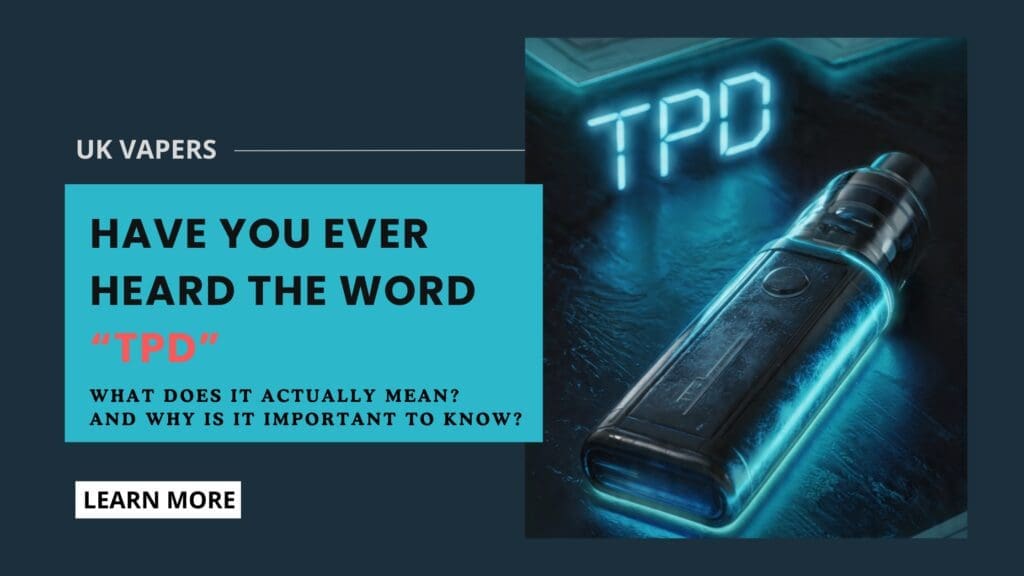
If you’ve been vaping for a while, you’ve probably heard the term “TPD” thrown around — maybe on a product page, in a vape shop, or somewhere online. But what does it actually mean, and why should you care?
Let’s break it down.
So, What Is the TPD?
TPD stands for the Tobacco Products Directive. It’s basically a set of rules introduced by the European Union to regulate tobacco and vaping products across member states. The UK adopted its own version — often called the TRPR (Tobacco and Related Products Regulations) — and it still applies post-Brexit.
Think of it as the rulebook that governs what vaping products can legally be made, sold, and used. It covers everything from how much nicotine can be in your e-liquid to how big your tank can be.
The Key Rules You Need to Know
Here’s what TPD compliance actually looks like in practice:
E-liquid bottles are capped at 10ml if they contain nicotine. You’ve probably noticed those small bottles at the checkout — that’s why. Larger bottles are available, but only in 0mg (nicotine-free) shortfills.
Nicotine strength is limited to 20mg/ml. If you see anything stronger than that being sold as TPD-compliant in the UK or EU, something’s off.
Tanks and pods are limited to 2ml capacity. This applies to refillable devices. It’s one of the more debated rules, since many vapers feel 2ml runs out too quickly.
All products must be notified to the MHRA (Medicines and Healthcare products Regulatory Agency) before they can be sold in the UK. This means manufacturers have to submit detailed safety information about every product.
Packaging must include health warnings — you’ll see the standard “This product contains nicotine which is a highly addictive substance” on every compliant product.
Why Were These Rules Introduced?
The TPD wasn’t created to make life difficult for vapers. The intention was genuinely to make the industry safer — especially to protect younger people and ensure that products on shelves have been properly tested and approved.
Before these regulations, the vaping market was a bit of a wild west. Products varied wildly in quality, ingredients weren’t always disclosed, and there were no consistent safety standards. The TPD changed that by bringing some much-needed structure to the industry.
What Does This Mean for You as a Vaper?
Honestly, for most everyday vapers, TPD compliance is a good thing. It means the products you’re buying have gone through a proper notification process, the ingredients are disclosed, and the nicotine levels are within tested limits.
That said, there are some trade-offs:
- You’ll go through e-liquid bottles faster because of the 10ml cap — though shortfills have become a popular workaround.
- Stronger nicotine options are limited, which is why nicotine salts at 20mg have become so popular — they deliver a smoother, more satisfying hit within the legal limit.
- Some devices from other markets may not be TPD-compliant, so always check before buying, especially from overseas sellers.
Shortfills — The Smart Workaround
Since nicotine-containing liquids are capped at 10ml, brands came up with a clever solution: shortfills. These are larger bottles (50ml, 100ml) filled slightly below capacity with 0mg e-liquid, leaving room for you to add a nicotine shot yourself.
It’s completely legal, widely available, and gives you access to bigger quantities at better value. Win-win.
Are the Rules Going to Change?
Possibly. There’s ongoing conversation in the UK about updating vaping regulations, particularly around disposable vapes and environmental concerns. The government has already moved to ban single-use disposables, and further changes to nicotine limits and packaging rules could follow.
The best way to stay up to date is to follow reputable vaping news sources or check the MHRA’s official guidance from time to time.
The Bottom Line
TPD regulations exist to make vaping safer and more transparent. While some of the rules feel restrictive — especially the 2ml tank limit and the 10ml bottle cap — they’ve genuinely helped clean up an industry that needed some standards.
As a vaper, the most important thing is to buy from reputable, compliant retailers. If a product seems too good to be true — unusually high nicotine levels, massive tanks, no health warnings — it’s worth asking whether it’s actually legal and safe.
Vaping smart means knowing the rules. And now you do.